Estrogen Replacement Options
Estradiol Patch Shortage: What to Know & Understanding Your Other Options
If you use an estradiol patch and have recently had trouble getting your prescription filled, you are not alone.
There are currently supply issues affecting certain brands and strengths of estradiol patches. This is a nationwide issue. Availability can vary by manufacturer, dose, and pharmacy, which means one pharmacy may be unable to fill a prescription while another may still have it available.
We know this can be frustrating—especially when you've found a hormone regimen that is working well for you.
If you are a Rural Revival patient and your pharmacy cannot get your estradiol patch, please contact our office. Rather than going without your medication or making changes on your own, we can discuss your options and determine the best alternative for you.
And this brings up an important topic:
The patch is only one way we can replace estrogen.
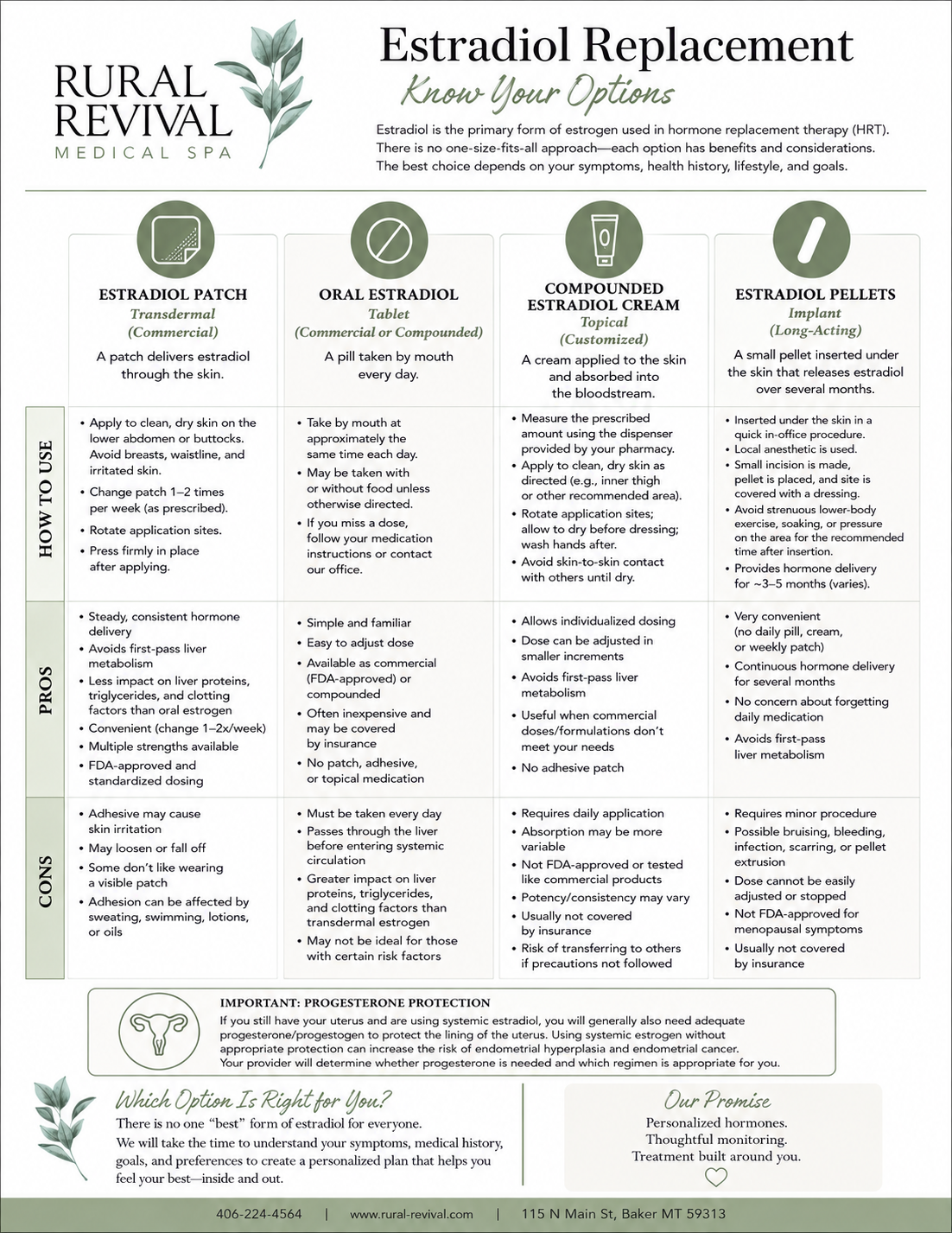
There are several forms of estradiol replacement, and each has its own advantages and considerations.
First, What Is Estradiol?
Estradiol is the primary form of estrogen commonly used in hormone replacement therapy (HRT).
As estrogen levels decline during perimenopause and menopause, women may experience symptoms such as hot flashes, night sweats, sleep changes, brain fog, mood changes, vaginal dryness, changes in sexual health, joint discomfort, and changes in overall quality of life.
When hormone therapy is appropriate, estradiol can be used to replace some of the estrogen the body is no longer producing.
The question then becomes: How should you take it?

Option 1: Estradiol Patch
Estradiol patches deliver estrogen through the skin and into the bloodstream. Depending on the product, the patch is typically changed once or twice per week.
For many women, this is one of our preferred starting options.
Why we like it
The patch provides steady hormone delivery and bypasses the liver's first-pass metabolism. Transdermal estrogen also has less impact on clotting factors and triglycerides than oral estrogen, which can make it preferable for certain patients.
Commercial estradiol patches are FDA-approved and available in standardized doses.
The downsides
Some women experience skin irritation, difficulty keeping the patch adhered, or simply don't like wearing a patch.
And, as many patients are discovering right now, availability can occasionally become an issue.
Option 2: Oral Estradiol
Estradiol can also be taken as a daily pill. Oral estradiol is available commercially and can also be compounded when individualized dosing is needed.
Why we like it
It's simple, convenient, easy to adjust, and commercial formulations are often inexpensive.
The downsides
Unlike transdermal estrogen, oral estradiol passes through the liver before entering systemic circulation. There are many cardiovascular and cholesterol lowering benefits to this form. The downside is there is an increased risk of blood clots in higher risk individuals.
That doesn't make oral estradiol a “bad” form of estrogen. It simply means we need to consider your individual health history and risk factors when deciding whether it's appropriate for you.
Option 3: Compounded Estradiol Cream
Estradiol can also be compounded into a cream that is applied to the skin.
Why we like it
The biggest advantage is customization.
Compounding allows us to prescribe doses that may not be commercially available. This can be helpful when someone needs more individualized dosing or doesn't tolerate other delivery methods.
Like the patch, transdermal cream avoids first-pass liver metabolism.
We have many patients who use compounded estradiol cream and love it.
The downsides
Cream must be applied consistently, and absorption can be more variable than with FDA-approved products.
Some patients find it cumbersome and messy. It can rub off on clothing or bedding if not allowed to dry completely.
Option 4: Estradiol Pellets
Estradiol pellets are small implants placed underneath the skin, typically in the upper buttock/hip area. They gradually release estradiol over several months.
Why we like them
Convenience is the biggest advantage.
There is no daily pill, cream to apply, or patch to remember. For women who prefer a long-acting option, pellets can be appealing.
We often pair estradiol pellets with testosterone pellets.
The downsides
Pellets require a minor in-office procedure, and once a pellet has been inserted, the dose cannot easily be adjusted or discontinued.
This is an important distinction. If you don't tolerate a pill, patch, or cream, we can simply change the dose or stop the medication. With a pellet, we generally have to allow the hormone to gradually wear off.
Estradiol pellets used for menopausal hormone therapy are also not FDA-approved in the United States.
A Quick Note About “Bioidentical” Hormones
This is an area where there is a lot of confusion.
Bioidentical does not mean compounded.
Many commercially manufactured estradiol patches and tablets contain 17β-estradiol, which is chemically identical to the estradiol naturally produced by the human body.
Compounding can be very useful when customized dosing is needed, but a hormone does not have to come from a compounding pharmacy to be considered bioidentical.
What About Progesterone?
Estrogen is only one piece of hormone replacement.
If you still have your uterus and are using systemic estrogen, you will generally also need adequate progesterone/progestogen to protect the lining of the uterus.
Your hormone treatment should always be evaluated as a whole rather than simply looking at one hormone or one lab value.
There Is No One “Best” Form of Estrogen
If there is one thing we want women to understand about hormone replacement therapy, it's this:
There is no single protocol that is right for everyone.
For one woman, an estradiol patch may be the perfect fit. Another may prefer a pill. Someone else may benefit from customized compounded dosing, while another patient may value the convenience of pellet therapy.
Your medical history matters. Your symptoms matter. Your risk factors matter. And your preferences matter, too.
Medication availability can change as well—as we're currently seeing with estradiol patches. Having multiple treatment options allows us to adapt when necessary without losing sight of the ultimate goal.
At Rural Revival, hormone care isn't about putting every woman on the same protocol. It's about understanding where you are, what you're experiencing, and what you're hoping to improve—and then building a treatment plan around you.
Current patient having trouble filling your estradiol patch? Please contact our office before making changes or going without your medication. We'll help you determine the best next step.
Medical Disclaimer
This information is provided for educational purposes only and is not intended to replace individualized medical advice, diagnosis, or treatment. Hormone replacement therapy is not appropriate for everyone, and treatment decisions should be made with a qualified healthcare provider based on your individual medical history, symptoms, risks, and goals. Do not start, stop, or change your medication without discussing it with your healthcare provider.